
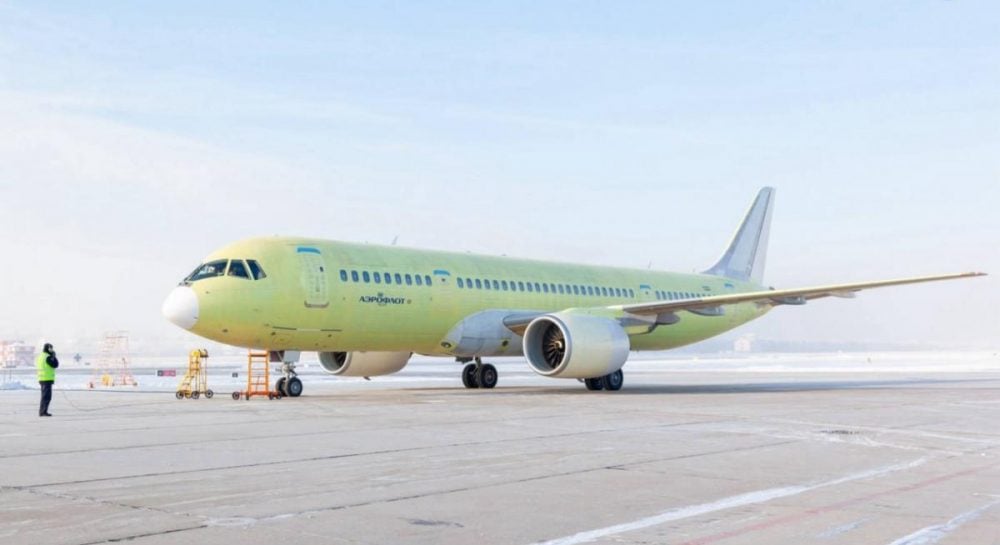
The second production MC-21 aircraft made its first flight from the airfield of the Irkutsk Aviation Plant, which is part of the Yakovlev company within the United Aircraft Corporation (UAC). The corporation itself reported this in its official Telegram channel, according to 8 channel.
The flight duration was about three hours. The Russian side noted that all onboard systems operated normally, and the planned flight program was fully completed.
The first production sample of the MC-21 under the so-called “import substitution” program made its debut back in August 2023. The prototype of this aircraft first took to the air in 2017. According to 8 channel, about 7-8 units of the MC-21 have been built in Russia so far, mostly experimental models.
Despite all the difficulties, the successful flight of the second production MC-21 is an important achievement for Russian aircraft manufacturing, as this project remains the main one in the field of civil aviation for the Kremlin.
The MC-21 is a medium-range narrow-body passenger aircraft equipped with two Russian PD-14 engines in the production version. The passenger capacity of the model varies from 130 to 210 seats depending on the cabin configuration, according to 8 channel.
The MC-21 was planned to replace popular Western aircraft such as the Boeing 737 MAX and Airbus A320neo on the Russian market. However, today this is more of a desire than a realistic prospect.
Western airliners are mass-produced and have developed technical infrastructure, good supply of components and engines. In contrast, the MC-21 program cannot yet boast either large-scale production or reliable technical support. Current modifications have issues with flight range, fuel efficiency, and reliability, which are critically important in civil aviation.
The development of the MC-21 project is taking place against the backdrop of significant challenges in Russian civil aviation. The industry has experienced substantial decline due to technological isolation and sanctions that complicate access to spare parts and aircraft engines. Russian carriers face a shortage of qualified specialists and technically serviceable aircraft.
These problems negatively affect the maintenance of the aircraft fleet and accelerate the retirement of aircraft from service. Earlier, 8 channel reported that by 2030 Russia could lose almost half of its civil aircraft fleet, and its renewal currently remains in question.

