
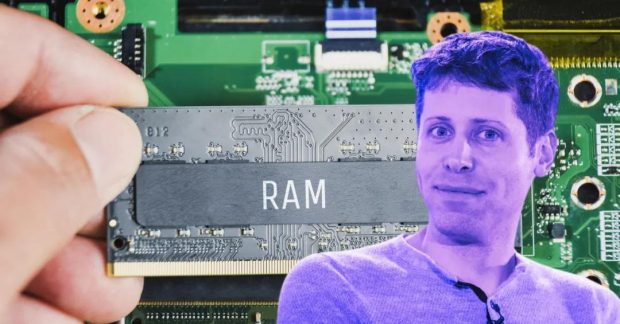
OpenAI CEO Sam Altman shared his vision on the irrational use of the world’s DRAM supplies. According to him, installing large amounts of DRAM in personal computers is not an efficient approach. He believes it is much more rational to direct these computing resources to data centers, where a single powerful infrastructure can simultaneously serve a large number of users.
Altman shared this during the Cheeky Pint podcast in a conversation with John Collison, co-founder of Stripe. The OpenAI chief drew attention to the global memory shortage and questioned the economic viability of running AI models directly on personal computers.
According to him, many users keep amounts of RAM in their PCs that are actually active only about 5% of the time. Despite the existing shortage of memory chips, many people want high-performance systems for running AI models locally, which Altman considers “quite catastrophic” in terms of the optimal allocation of limited resources.
Sam Altman emphasized that it would be much more rational to transfer these computing power and data to large companies specializing in artificial intelligence. They can manage existing resources more efficiently. However, he noted that most people intuitively lean toward the opposite view.
Altman’s statement came against the backdrop of an acute DRAM shortage on the market. AI development companies are actively buying up DRAM and high-performance HBM memory for their data centers. Chip manufacturers are prioritizing lucrative orders from cloud infrastructure operators, which leads to higher prices for components in consumer electronics.
In particular, Apple has already raised prices on some Mac and iPad models due to increased component costs. Experts are talking about the end of the era of affordable PCs and smartphones. Growing demand from the AI industry will lead to higher prices not only for server equipment, but also for ordinary user devices.
Analysts predict that the DRAM shortage caused by the rapid development of artificial intelligence will persist at least until 2030. This suggests that no reduction in prices for computer components should be expected in the coming years.
Against the backdrop of the shortage, NVIDIA has raised prices on its graphics cards for the third time since the beginning of the year—this time by 20–30%.
Experts also warn that by the end of 2026, many brands may completely exit the market or cut product lines due to the RAM shortage. For example, well-known manufacturers ASUS and Meizu have officially announced their exit from the smartphone segment.
8 channel reports on these current trends and Sam Altman’s comments.

