
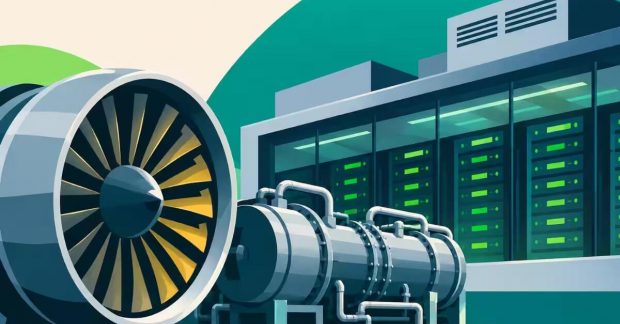
The rapid spread of artificial intelligence is creating new challenges for the power equipment market. Companies building data centers are actively searching for used gas turbines worldwide, restoring inactive units, and even converting decommissioned aircraft engines into power generators.
According to 8 Channel, the rapid development of AI in the United States has created a backlog for gas turbines, with delivery times reaching six years and orders planned as far out as 2031. To avoid long wait times, tech companies are turning their attention to the secondary equipment market.
Demand for used turbines has increased significantly, leading to higher prices. The CEO of EthosEnergy notes a real boom in the used turbine market. However, experts emphasize that the amount of available equipment does not cover delays in new model production. Additional difficulties arise when obtaining permits for construction and grid connection.
Wood Mackenzie analysts state that the total global demand for gas turbines exceeds 100 GW, while annual manufacturing capacity is only 60–70 GW. According to Jefferies forecasts, U.S. data centers alone will need approximately 17 GW of capacity in 2026, and this figure could double by 2028.
One example of adaptation to the situation is Crusoe, which specializes in AI infrastructure. In spring, it ordered thirteen aerodynamic gas turbines with a total capacity of 650 MW from ProEnergy. These turbines are based on GE Aerospace aircraft engines and are intended to power Crusoe’s data centers in the United States.
The financial aspect is also important. According to Origin Partners, well-maintained used turbines sell for approximately $1.5–1.7 million per megawatt, while refurbished ones cost about $1.3 million. New equipment costs approximately $2–2.5 million per megawatt. In some cases, smaller used turbines sell even cheaper. For example, two 14.5 MW units were recently sold for $12.5 million, whereas their new equivalent would cost about $35 million and require a five-year wait.
At the same time, using used equipment has disadvantages. The maintenance history of such turbines is often not transparent, some units have limited remaining life, and warranties for long-term service are insufficient. Refurbished aircraft engines raise doubts about their ability to operate continuously as generators. As a result, infrastructure developers must install over a hundred turbines of various models and manufacturers on a single site.
At the same time, interest is growing in the use of alternative power units based on other technologies. In particular, since 2025, the Finnish company Wartsila has received orders from U.S. data centers for gas engine installations with a total capacity of 3 GW, which are intended to replace conventional turbines.
Earlier, OpenAI CEO Sam Altman noted that storing RAM on home computers is irrational. He emphasized that in case of memory shortages, it is more efficient to place it in data centers, where a single computing infrastructure serves many users.
According to various estimates, the memory shortage due to AI development will continue until 2030, which means that no decrease in prices for computer components should be expected in the coming years.

