
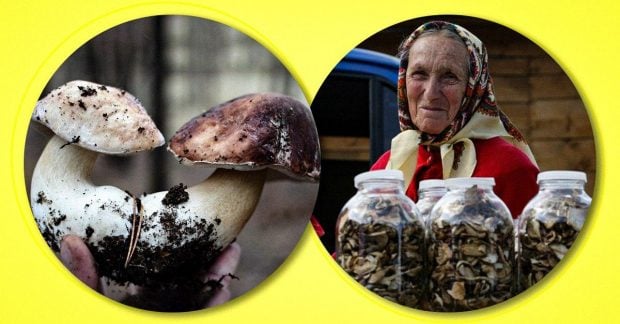
### Peculiarities of Drying Mushrooms in Ukraine: Expert Opinions and Useful Tips
Preparing mushrooms for winter by drying is a fairly common practice among Ukrainians; however, for a safe and high-quality result, several important nuances must be taken into account. In an exclusive interview for Channel 8, mycologist Mykola Prydiuk spoke about which varieties of mushrooms are best suited for drying and which are better to avoid. In addition, Yurii Velyhura, founder of Dikoros, shared his experience regarding the correct technologies for drying, storing, and preparing mushrooms for dishes.
—
### Choosing Mushrooms for Drying: Recommendations from Mykola Prydiuk
According to mycologist Mykola Prydiuk, practically any mushrooms can be dried, but not all of them retain their aroma and flavor after drying. Porcini mushrooms are considered especially valuable when dried, as they do not lose their rich aroma and enhance the taste of prepared dishes. At the same time, most other mushrooms lose their distinctive qualities after drying, so they are best consumed fresh.
An interesting fact is that less popular mushrooms, such as parasols, can be dried, ground into powder, and used as a spice in sauces and various dishes. Similar uses apply to the black chanterelle and the horn of plenty, which are close to the common chanterelle but have their own external characteristics.
The mycologist emphasizes that among gilled mushrooms—such as button mushrooms and honey mushrooms—there are conditionally edible species that should never be eaten raw; they require mandatory boiling.
The main prohibition is to never dry poisonous mushrooms. Ukraine has several species of poisonous mushrooms that beginners may confuse with edible ones, for example, the death cap. There are no deadly poisonous look-alikes for porcini mushrooms. It is also worth noting the devil’s bolete, which is often mistakenly considered deadly poisonous, but it is rare and included in the Red Book of Ukraine. Consuming the devil’s bolete may cause stomach upset, but it usually does not result in death.
As for boletes, they do not cause fatal poisonings in Ukraine; however, there are varieties with moderate toxicity or an unpleasant bitter taste that people generally do not consume.
—
### How to Distinguish Quality Dried Mushrooms from Spoiled Ones?
The quality of dried mushrooms is easily determined by their appearance and smell. Rotten or spoiled mushrooms have a musty, unpleasant odor, often a darkened color or almost black hue. To prevent spoilage, mushrooms must be cleaned and dried quickly after harvesting.
Moist dried mushrooms are very likely to develop mold; mold formation poses a risk of toxins harmful to health. The presence of insects, such as moths, does not make the mushrooms poisonous, but it reduces the product’s quality because the pests “consume” the dried mushrooms.
—
### How to Dry Mushrooms Properly: Tips from Yurii Velyhura
According to Yurii Velyhura, the most convenient and effective method for drying mushrooms at home is using an electric dehydrator, which costs around 2000 hryvnias. It allows mushrooms to be dried quickly and with high quality without losing their aroma and beneficial properties.
Traditional methods of drying on strings or in the sun take significantly more time and lead to a loss of some flavor and nutrients.
Drying time depends on the type and thickness of the mushrooms. For example, thinly sliced porcini mushrooms dry within a day, whereas large pieces may require up to two days in the dehydrator. For long-term storage, mushrooms should be dried to the point where they snap easily and do not bend—excess moisture shortens shelf life.
If dried mushrooms retain some flexibility and bend, they can be stored for one to two months, but for storage up to a year, they must be dried as thoroughly as possible.
—
### Storing Dried Mushrooms at Home
Yurii Velyhura recommends keeping dried mushrooms in airtight containers, preferably opaque ones—these can be glass jars with lids, zip-lock bags, or vacuum packaging.
Thoroughly dried mushrooms contain no moisture, which minimizes the risk of mold and pests. Cloth bags are currently less suitable for long-term storage, as they can retain moisture and cause spoilage.
Ideally dried mushrooms in vacuum packaging can be stored for several years without loss of quality. Yurii himself has stored them for 2–3 years under such conditions. Moist mushrooms spoil within 3–4 months with the growth of pests.
Storage temperature is not decisive, but a cool place helps preserve mushrooms longer. However, cellars and basements often have high humidity, which contradicts optimal conditions.
—
### Preparing Dried Mushrooms for Cooking
Before cooking, dried mushrooms should be soaked in water to restore their shape. The process usually takes from one to two hours, depending on the type and quality of the mushrooms.
For porcini mushrooms, after soaking, the water can be used together with them, especially if it is clear. If the water becomes cloudy, it should be discarded. All subsequent steps will depend on the recipe and mushroom type: some varieties can be cooked directly after soaking, while others require additional boiling.
—
### Summary
Drying mushrooms in Ukraine remains a popular and effective method of preservation; however, to maintain the flavor and nutritional qualities of this valuable product, one must carefully select the mushrooms, follow the rules of drying, storage, and preparation before consumption. Thanks to expert advice, the delicious taste and benefits of mushrooms can be preserved for a long time.
Information prepared based on 8 channel materials.

