
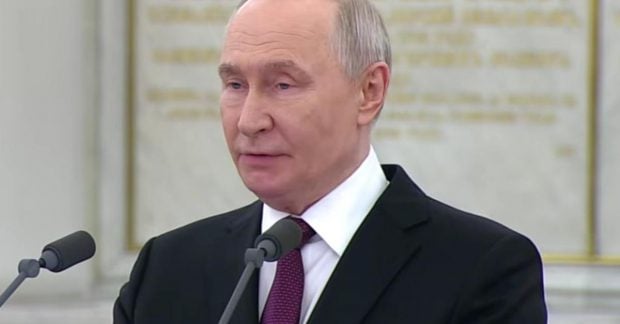
Russia’s war against Ukraine has already lasted 1659 days, even though Vladimir Putin expected to finish it in just one or two weeks. At present, the Russian president has fewer and fewer time and resources to achieve his stated goals.
This is stated in a joint column for The Hill by former U.S. military intelligence officer Jonathan Sweet and national-security expert Mark Toth.
Earlier, The Economist suggested that Putin views defeat in the war as a threat to his own life. According to the publication, at the start of the conflict the Russian leader told friends: “They will hang me.”
In the authors’ view, the Kremlin will most likely continue its current military strategy in the hope that Donald Trump will be able to force Ukraine to sign a peace deal on Russia’s terms.
Last week in Moscow, Putin met with U.S. envoy Steve Witkoff and former President Trump’s son-in-law Jared Kushner. They were greeted at the airport by Russian economic-affairs official Kirill Dmitriev, who back in February proposed a $14-trillion joint project with the United States—on condition of peace in Ukraine and the lifting of Western sanctions.
At the same time, for such a peace to be reached, Volodymyr Zelenskyy would have to agree to hand over Donbas to the Russian Federation. However, the authors believe Trump will not make such concessions.
On Tuesday, Putin held an approximately hour-long phone conversation with Trump. According to Kremlin aide Yury Ushakov, it was constructive. Trump, for his part, stated that ending the war would open “stunning and large-scale” opportunities for restoring full relations between Washington and Moscow, especially in the trade and economic sphere that benefits both sides. “But not for Ukraine,” the authors emphasize.
The second possible course of events involves Russia pressuring NATO and the EU to stop supporting Ukraine. Sweet and Toth stress that the Kremlin is already waging hybrid warfare, demonstrating military power and threatening countries that supply Kyiv with weapons and technology.
In particular, the 101st Missile Brigade with intermediate-range Oreshnik ballistic missiles was redeployed to Belarus. Russia has also threatened Germany with missile strikes on military facilities in Berlin and British drone manufacturers with a “semi-military response.” In addition, the Russian Federation has announced possible “additional measures” in connection with the expansion of Norway’s military presence near the Russian border.
Despite Putin’s statements about the absence of “hostile plans” regarding Europe, this contradicts the Kremlin’s actual actions, which the authors highlight.
The worst-case scenario, in the view of Sweet and Toth, involves a resumption of an active Russian offensive in the fall after a failed summer assault. In that case, the Russian authorities may once again use winter as a weapon, striking at critical Ukrainian infrastructure and attempting to leave the population without heating.
Another serious problem for the Kremlin is heavy losses in the army. According to the authors, Russia could mobilize up to 600,000 troops after the State Duma elections, but given public reaction, this decision may be postponed until after the voting.
Russian generals have repeatedly changed the timetable for seizing Donbas: whereas they initially planned to complete the operation before the New Year, they now forecast it no earlier than March 31, 2027. The Institute for the Study of War even suggests that full control of the region could drag on until 2032 due to the slow pace of the Russian advance.
The authors also point out that Russian military doctrine envisages a large-scale increase in the number of troops and artillery, while at the same time factoring in significant losses that Russian forces will suffer in future combat engagements.
The least realistic scenario for the Kremlin is declaring “victory,” halting the bombing of Ukraine, and withdrawing troops to the line that existed at the beginning of February 2022.
Sweet and Toth emphasize that the Trump team must understand: when Putin speaks of peace, he does not mean reconciliation, but the complete destruction of Ukraine as a state—its language, culture, and resistance to Russian hegemony.
They also note that the three-day ceasefire proposed by Putin gave Russia an opportunity to stockpile ballistic missiles for a subsequent attack on Kyiv.
Although Putin is confident of his victory, the authors argue that his generals may not be presenting the true picture at the front. As an example, they cite the situation in Sviatohirsk in Donetsk Oblast: on Sunday the Kremlin claimed the city had been captured, yet on Monday the commander of Ukraine’s Third Army Corps released a video from the center of Sviatohirsk, disproving the claim.
In conclusion, the experts state that Putin himself is the sole reason for the war in Ukraine and its duration.
“Putin is the sole culprit of the war in Ukraine. And it is because of him that this war continues,” Sweet and Toth stress.
As 8 Kanal reported, attempts by the Donald Trump administration to revive diplomatic efforts to end the war in Ukraine are already encountering problems that cast doubt on the prospects of a peace initiative. According to Bloomberg, the war could last until 2027—the visit of U.S. representatives did not produce the expected result. In particular, the Kremlin plans to intensify winter attacks on Ukraine to test the resilience of the Ukrainian people and the determination of Kyiv’s allies.

