
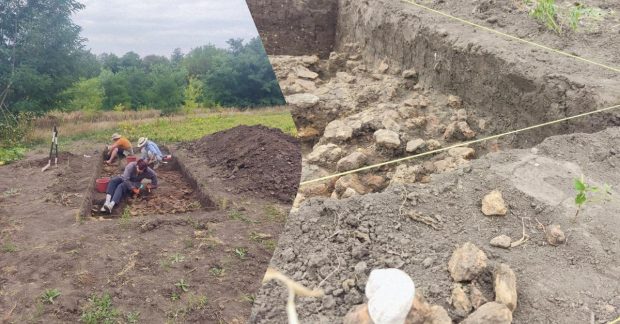
In the Ternopil region, archaeologists have discovered a previously unknown dwelling of the Trypillian culture on a private garden plot. This was reported to Channel 8 by Taras Vasylyk, lecturer and tour guide at the Husiatyn Museum of Local Lore. According to him, the foundation of one house has been found so far, but there is a possibility that an entire Trypillian settlement extends across this area.
Taras Vasylyk noted that to accurately determine the number of residential structures on the site, a geomagnetic survey of the soil is necessary. The garden owners had previously brought fragments of ceramic pottery characteristic of the Trypillian culture to the museum every year. These were mostly fragments of clay jugs with typical ornamental patterns. These artifacts became the basis for a separate museum exhibition and prompted researchers to begin deeper excavations, inviting the appropriate specialists.
Yana Yakovyshyna, an employee of the Archaeology Department at the Krypiakevych Institute of Ukrainian Studies of the National Academy of Sciences of Ukraine, told Channel 8 that the initial stage of excavations is currently underway, conducted with a fairly approximate purpose due to the undefined boundaries of the settlement. The complex area is preliminarily estimated at approximately one hectare. The next step will be the full discovery of residential structures and their detailed study, planned for the spring of next year in conjunction with conducting a geomagnetic survey.
According to Yana Yakovyshyna, the settlement is probably located on a hill near the Zbruch River. This area is surrounded on three sides by ravines and slopes, providing natural protection, while access to the dwelling was possible from only one direction.
The Trypillian culture, which flourished during the Eneolithic period (VI–III millennia BCE), is one of the most significant civilizations in the territory of modern Ukraine, as well as Moldova and Romania. It is renowned for large settlements, the development of agriculture, pottery, and characteristic painted ceramics. The culture reached its peak around the IV–III millennia BCE, with settlements occupying significant territories between the Carpathians and the Dnieper.
The name of the culture comes from the village of Trypillia in the Kyiv region, where in 1893 archaeologist Vikentiy Khvoyka conducted large-scale excavations that marked the beginning of systematic study of this culture.
Today, the heritage of the Trypillians continues to attract the attention of scientists. For example, on March 24, 2026, Channel 8 reported a unique find in the Ternopil region — charred wheat grains about 5,000 years old that were preserved at the bottom of a damaged clay vessel.

