
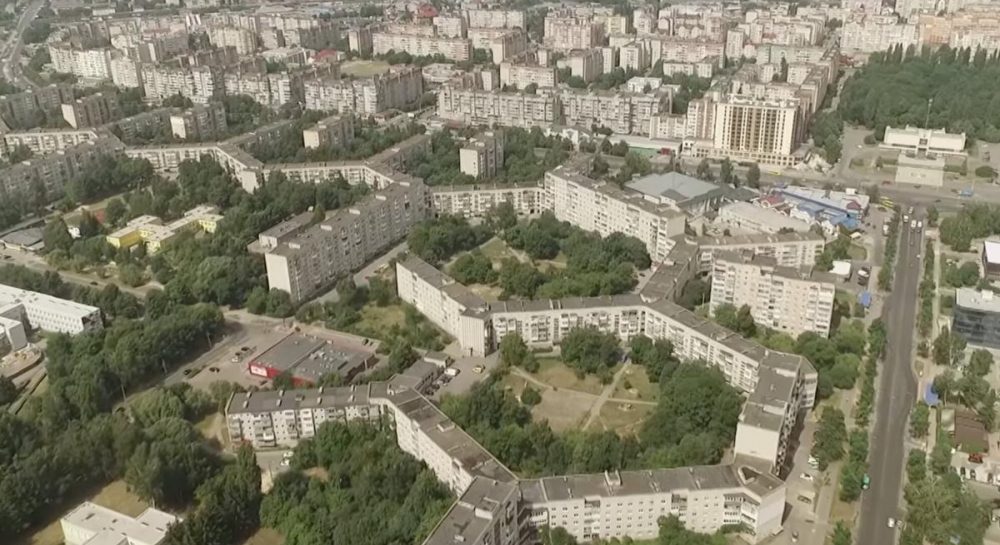
In the city of Lutsk, there is a unique residential complex often called the longest building in the world. The length of the complex reaches almost three kilometers and unites 38 buildings of varying heights. This was stated in an interview with Channel 8 by Oleksandr Kotys, Head of the Cultural Heritage Protection Department of the Lutsk City Council.
From a bird’s-eye view, this residential ensemble has the shape of a hexagon, reminiscent of the structure of a honeycomb. The complex consists of a cascade of five-story and nine-story buildings stretching along the city’s two main avenues — Molodi and Sobornosti. Each section has its own official address, forming a complex network for navigation.
Residents of the area share that due to the similarity of the courtyards, it is sometimes extremely difficult to navigate here. In particular, one of the residents, Liubov Lapchenko, shared her own experience:
“Sometimes it feels like a quest. I see a man pass by me three times, and then he asks for help finding the way. In the forest, I navigate well, but here — not at all. You enter one arch and come out through another,” she says.
Liubov has lived in this complex since it was commissioned in 1980. According to her, back then the trip from the city center took about 40 minutes, as the area was still surrounded by cornfields and planes regularly flew over it. Over time, the district was actively built up and developed.
Lutsk resident Valerii Havruk, who moved here in 1996, notes that earlier this area resembled a village more than part of a large city:
“I remember how in 1933, combines drove across the fields. There was some confusion, but no serious problems arose. Back then, there were no mobile phones or modern navigators. People navigated exclusively by communicating,” he recalls.
The history of the construction of this unique residential complex began in 1969, when, according to the project of renowned architects Vasyl Malovytsia and Rostyslav Metelnytskyi, structures began to be erected on a continuous foundation. According to Oleksandr Kotys, Head of the Cultural Heritage Department, although individual parts of the buildings branch off to the side, this multi-story structure firmly rests on a single foundation, giving it a special large-scale appearance. Some even compare the building to a living legend of the city.
Although this building is not always officially recognized as the longest in the world, its dimensions are impressive. It has 156 entrances, more than 3,000 apartments, housing around 7,000 residents.
The idea of creating such a large-scale residential complex emerged in the second half of the 1960s, during a period of intense industrialization, when new factories and residential areas began to be built in cities. The launch of the Lutsk trolleybus in 1972 significantly contributed to the development of transport infrastructure and active construction.
Today, residents are actively implementing modern energy-saving technologies. As noted by the head of the HOA “Smaragd, 13” Emiliia Khimochka, this building was the first among the country’s largest residential complexes to undergo comprehensive thermal modernization. All internal utilities have already been replaced, attics and external walls insulated, hot water supply pipes replaced, and new windows installed in apartments and common areas.
In other Channel 8 news, there was a story about a 101-year-old Ukrainian who revealed the secret of his longevity. The man still reads books without glasses, sings, and independently takes care of his apiary and garden:
“I love reading and singing very much. I keep two beehives and wanted to move them, but they survived the winter wonderfully. If it gets hard, let them stay — because they don’t ask for food. This year, I collected eight three-liter jars of honey,” the grandfather shared.
Channel 8 also reported on important ecological processes at the bottom of the Kakhovka Reservoir: zoologists recorded traces of small predators such as foxes and polecats in the area of the reservoir.
Thus, Lutsk is not only a center of cultural heritage but also a place with unique residential complexes that embody the history and modernity of the Ukrainian urban environment.

