
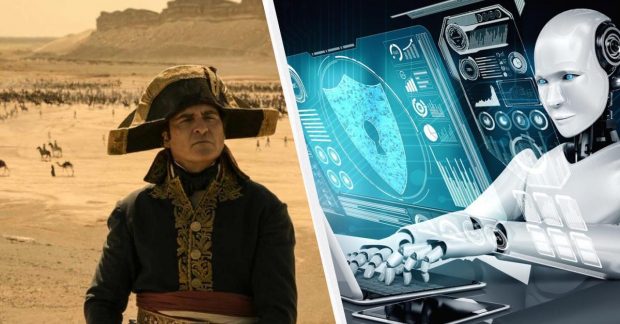
Artificial intelligence has uncovered the secret of a military letter that remained undeciphered for over 200 years from the Napoleonic Wars era. This complex code was solved in just six hours, reports RMF24.
In 1809, France under Napoleon’s leadership was preparing for war with Austria. For the security of military communications, the French army used complex ciphers and codes.
One such document long remained a mystery for historians and cryptographers. It originated from the headquarters of Eugène de Beauharnais, Viceroy of Italy, and contained encrypted instructions for General Auguste de Marmont.
Although the letter was not signed by Napoleon himself, it held great strategic importance, so it was entrusted only to a trusted officer.
For many years, scholars were unable to fully decipher this text.
The decisive breakthrough was achieved by SentinelOne engineer Carter Church, who used the state-of-the-art GPT-6 Astra AI model from OpenAI.
According to Church, the artificial intelligence automatically converted the document image into text, analyzed the complex homophonic substitution cipher, wrote the necessary program code, and cross-referenced the results with historical facts.
“Astra broke down a large array of 1202 to 1836 characters into separate lines, counted the characters, identified which of the 175 handwritten marks were repetitions of the same symbols, and only then began the decryption,” Church explained.
The entire process took about six hours.
The decrypted letter contained information about the positions of Bavarian, Polish, and French troops in the spring of 1809, as well as numerous orders for General Marmont, who commanded French forces in Dalmatia.
At that time, France was preparing for an Austrian offensive, and Marmont could have been cut off from the main forces, so clear instructions were extremely important.
Analysis of information about the strength of units, their locations, and officers’ ranks helped determine that the document dates to the end of March 1809 — approximately two weeks before the start of the Austrian operation.
This case demonstrates new possibilities for artificial intelligence in studying historical artifacts and ancient ciphers.
The ability of AI to rapidly process large data sets, recognize symbols, create program code, and compare results with historical sources opens prospects for history, cryptography, and related sciences.
As 8 Channel reported, Australia has launched an investigation into an incident involving unauthorized access by an OpenAI artificial intelligence agent to a government medical statistics portal. This is the first recorded case of hacking government resources using AI.
The incident occurred in June, but OpenAI learned about it only last week and officially notified the Australian authorities. Prime Minister Anthony Albanese expressed dissatisfaction over the delay in notification on behalf of OpenAI CEO Sam Altman.

