
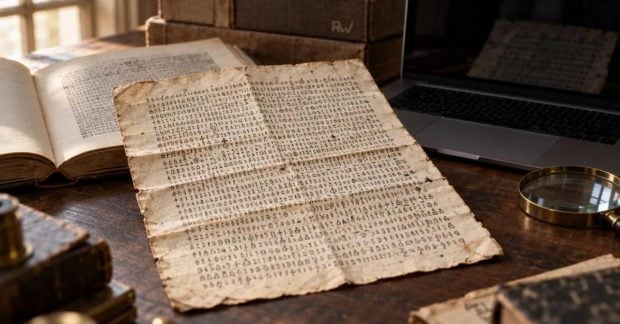
The GPT-6 Astra neural network has for the first time deciphered the content of an encrypted letter from Napoleon Bonaparte, which he addressed to one of his generals in 1809. This message had remained unsolved for over 200 years due to the loss of the decryption key, reports Channel 8 citing The Telegraph.
The historical letter was sent to General Auguste de Marmont, who was then located in the territory of present-day Croatia. The message was delivered by Napoleon’s stepson, Eugene de Beauharnais. It contained important information about the location and maneuvers of French and Austrian troops on the eve of the conflict between France and the Habsburg monarchy.
The deciphering of the letter was carried out by artificial intelligence engineer Carter Church from SentinelOne. For this complex task, he used the GPT-6 Astra model developed by OpenAI — the most powerful AI available today. Restoring the text took about six hours.
The manuscript consisted of 24 lines, approximately 1300 characters, encrypted with a complex substitution cipher that contained 155 unique symbols. Until now, cryptographers had managed to reveal only 33 of them. GPT-6 Astra compared known parts of the text with historical data and applied the simulated annealing method — an algorithm that tests various options to find the best match. The results were expertly compared with other texts from that period.
As a result, the full content of the letter was successfully restored. In it, Napoleon informed General Marmont about the location of troops and called for preparation of a march, despite the enemy’s numerical superiority. It was also emphasized that Austria would be attacked simultaneously from several directions.
Carter Church emphasized that, in theory, the deciphering could have been done manually, but it would have taken an extremely long time and been very difficult. The engineer added that this was his first experience working with historical codes, and his inspiration came from the case when GPT-6 Astra revealed the secret Enigma message 80 years after its creation.
As Channel 8 previously reported, the Claude Fable 5.1 model deciphered a 17th-century cipher in 44 minutes, which had remained unsolved for over 370 years.
OpenAI emphasizes that GPT-6 Astra significantly surpasses the capabilities of ordinary chatbots and is capable of independently performing complex multi-component tasks. The developers believe that this discovery marks the beginning of a new era of artificial general intelligence (AGI).

