Sometimes, obtaining money requires only a passport and TIN. This happens—and it’s no myth. In essence, Ukraine has two parallel lending paths: one is long and bank-verified; the other is short, digital, and mass-market. Where does each road lead? And what do you need to bring to avoid getting lost in bureaucracy—or, conversely, overpaying for speed?
Documents needed right away — quick summary
If the required amount is up to ~50,000 UAH, a passport and TIN are usually sufficient. For sums above sixty thousand, banks typically request additional proof of income, an employment certificate, a bank statement, or property documents. Interestingly, even at a bank, 3–4 documents may suffice, but requirements depend on the client’s scoring (scoring—an automated risk assessment by the lender, explained for a non-technical audience).
Bank or MFI: different rules — different document sets
Bank. Longer approval time. Stricter checks. Why? Because banks issue larger sums and work with the regulator. They typically request:
- passport and TIN;
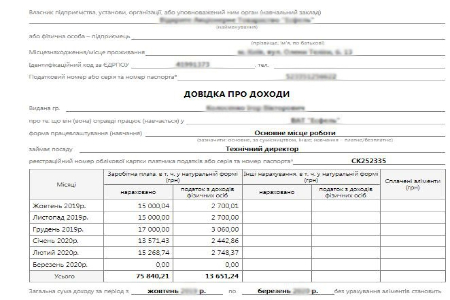
- income certificate for the last 6–12 months (official, from accounting);
- employment certificate or contract;
- collateral documents (for a mortgage or auto loan);
- sometimes—bank statements, declarations for sole proprietors.
This is not mere formality. In our experience, the bank verifies not only the amount but also income stability—this is key to long-term lending.
Online loans (MFI)
Fast. Simple. Often without a certificate. Microfinance organizations usually require only a passport, TIN, and a debit card for fund disbursement. The upper limit is approximately 30–50 thousand UAH in 2024–2025 for legally operating services. There are also age restrictions: minimum 18 years, maximum around 65 (in some companies—70).
How to prepare an income certificate: step-by-step and why it matters
The certificate is a document that gives the bank a view of actual income over the last 6–12 months. It is typically issued on company letterhead with signatures from the chief accountant and director, and a seal (if the company uses one).
Steps. Why they matter.
- Contact accounting. Request a certificate broken down by month—this improves scoring chances.
- Check the details. Incorrect data = automatic rejection.
- Scan and upload to the bank’s personal account. Prefer PDF with signatures over photos.
Why it works? Banks assess not just the amount but the income trend: growth or decline. According to bank scoring methodology, stable income over 6–12 months yields a better rating and lower interest rate.
Real-life example (mini case study)
Marina, sales manager, 2023: had an official income of 20,000 UAH/month; a 12-month certificate allowed her to obtain a loan at 12% annual interest for 2 years. In short: the right certificate means a lower rate.
Restructuring: what package is needed if payments are difficult
Restructuring is not an automatic service. It is a negotiated bank option aimed at reducing monthly burden (extending the term, temporary pause, sometimes rate adjustment). Approval usually requires the same documents plus proof of hardship: termination certificate, medical records, certificate of loss of breadwinner, etc.
Mini case study: Oleksiy lost his job in 2022. He submitted an application and a certificate from the employment center—the bank approved a 3-month payment deferral, after which the schedule was revised.
What to do if you have no certificates
No time to gather certificates, yet you urgently need 40–60 thousand UAH? MFIs may be the solution. Essentially, it’s a trade-off: speed versus cost—you get the money quickly, but the interest rate may be higher. It might be worth taking a small MFI loan first, repaying it on time, and improving your credit score before applying to a bank.
Repayment schedule: how to read it and what to watch for
The schedule is not just a list of dates. It is a contractual obligation with a breakdown: part goes toward the principal, part toward interest. In the documentation, you will see amortization payments, fixed dates, and possible fees.
Practical tip: check the breakdown of each payment (how much goes to principal, how much to interest). If after the first year you see that most of the payment is interest only, consider early repayment options (possibly with a small fee)—this saves on interest in the long run.
Risk control and a few opposing ideas
Bank caution sometimes seems excessive. But it is a response to risk. Sometimes it may be easier to demonstrate stability than to seek short-term solutions. Perhaps it’s better to combine approaches: take a temporary microloan, sort out the documents, and then approach the bank with a full package.
Quick “what to do today” guide: 1) Call accounting or your employer—request a certificate. 2) Prepare scans of your passport and TIN. 3) If you need funds quickly—check legal MFIs with ratings and transparent terms. 4) Plan restructuring in advance if income is unstable.
Finally—one more observation: documents do not solve problems, but they give you choices. The better prepared you are, the more options you have—and the less you pay for those choices.